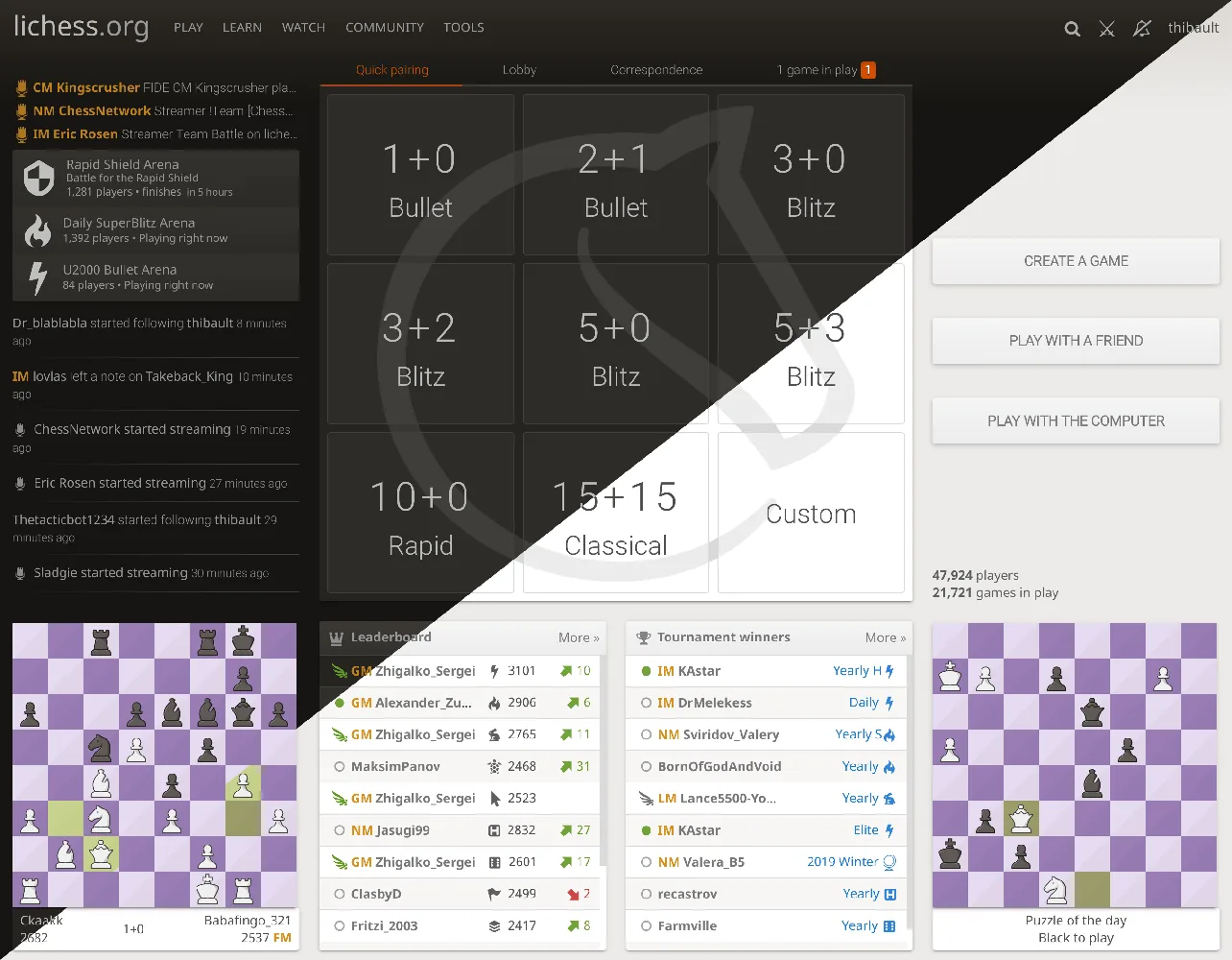

Lichess is an unusually clear answer to the question of what free can mean online. The board is the focus. You can play, study a position or work through a puzzle without a storefront competing for your attention.
All the moves. None of the paywall.
The organising idea is access. Rather than reserving its useful learning tools for a paid tier, Lichess makes play and study available together. That makes reviewing a mistake feel like a natural continuation of a game.
Chess offers a particularly visible relationship between action and consequence, but a fast clock can make that relationship hard to examine. Lichess is most useful as a combination of playing and reflecting. A single position you understand better can make a session worthwhile even when the result is a loss. Its open approach also lets you try learning tools without first deciding which tier of a subscription you need. That lowers the friction between noticing a question and investigating it.
A game with a history.
Thibault Duplessis began Lichess in 2010 as a hobby project. It grew into a free, open-source chess server supported by a community and donations. Its published account of that development is refreshingly direct: a small project improved as people contributed.
The moment-to-moment.
Choose a time control, play legal chess moves and manage the clock. Puzzles help you recognise patterns; analysis helps you revisit decisions afterwards. Faster is not automatically better: a slower game gives you time to work out why a move is useful.
Choose a time control that leaves room to check what changed after the opponent’s last move. Look for immediate threats before beginning your own plan. After the game, review it once using your own judgement, then compare the positions you found confusing with the analysis tools. An engine can identify a stronger move, but the practical lesson is an idea you can recognise next time. Work on one recurring pattern rather than memorising a list of corrections you do not understand.
Start with chess basics if needed, then choose a slower game. Afterward, find one mistake you understand instead of trying to fix everything.
Beyond the controls.
There is no fictional setting to learn. The history belongs to chess itself, while studies let people share annotated games and positions. The interest comes from what players see in the same sixty-four squares.
A detail worth noticing.
Lichess makes its source code public. Its about page describes a donation-funded approach without advertising or selling user data; that is a different model from the optional-purchase games elsewhere in this catalogue.
Why it’s on the shelf
- No paid gameplay tier
- Puzzles and analysis alongside online play
- Runs directly in a browser
Before you jump in
Human opponents can be much stronger than you. Use slower time controls and learning tools to make losses informative.
No entry fee.
Read the small print.
Playing, puzzles and analysis are free. Donations support the service and do not buy a gameplay advantage. Independent coaches listed on the platform may charge for their own services.
Canadian access depends on your device, age, account region and the publisher’s current terms. Check official availability and system requirements before installing. KAVRIQON does not sell currency, provide accounts or host the game.
Continue to LichessFacts checked against the official sources below on 4 November 2026. Recommendations and first-session advice are editorial judgement, not a claim of a scored play test. Release years refer to the game’s original release, not its free-to-play transition.
Artwork provenance and credits ↗